
Picks & Shovels
The AI gold rush won’t be won by prospectors; it will be won by whoever sells the picks and shovels.

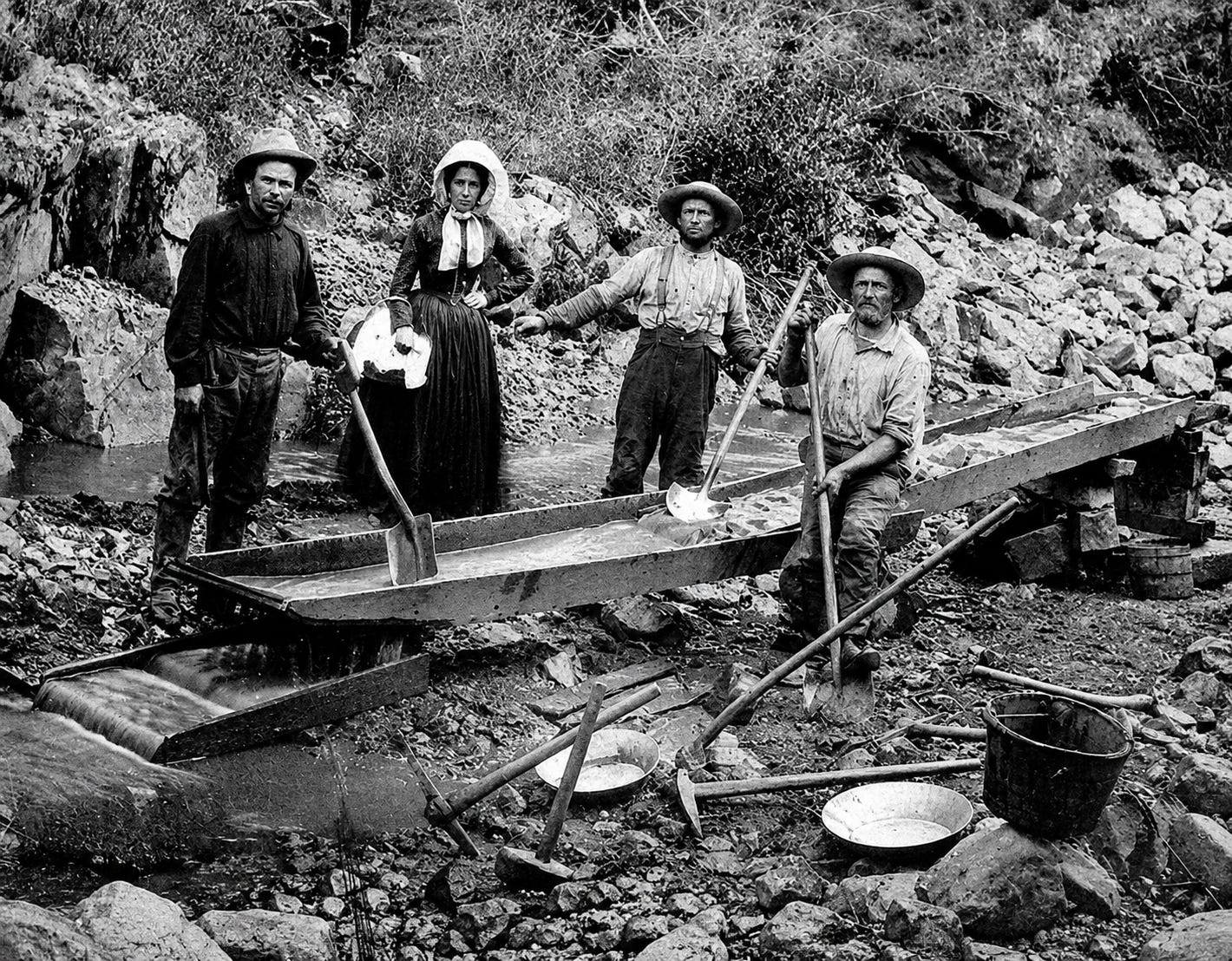
Every technological gold rush creates thousands of winners—or so it seems. History suggests otherwise. The fortunes that endure are rarely built by the prospectors themselves, but by those selling the picks and shovels.
Picking the winners and losers of the AI boom/bust isn’t hard if we look to San Francisco’s history. Spoiler alert: it’s infrastructure as opposed to applications.
Gold Rush Economics
San Francisco has been a boom and bust town going back as far as the gold rush in the mid-19th century. When prospectors first learned that “there’s gold up in them thar hills,” bringing an onslaught of covered wagons to Northern California, the vast majority ended up disappointed that the juice wasn’t worth the squeeze. The notable exceptions were found in the burgeoning industry that sold supplies and services to serve the seemingly endless influx of would-be millionaires. Levi’s was founded on the first use of denim in durable jeans used by prospectors in panning for gold, still today a juggernaut valued at $9B with $6B in annual revenue. In fact, the colloquial term used to describe critical infrastructure, “picks & shovels,” was named after Samuel Brannan, an entrepreneur who famously bought all the picks and shovels, establishing a monopoly and becoming the first Gold Rush millionaire. He promoted his sales by shouting “Gold! Gold from the American River!” up and down Market Street, now the central thoroughfare of San Francisco, and at the time, the place miners bought and sold gold. As an aside, there was such a rush to set up shop on Market Street that no one bothered to survey it, and it runs at a diagonal, hence why San Francisco’s city streets don’t line up in a neat and orderly grid. Wells Fargo bank, too, benefited disproportionately from the gold rush, and their stage coach iconography pays homage to this origin story.
Over the subsequent decades, San Francisco saw notable booms and busts including becoming the primary embarkation point for the Pacific theater during WWII with nearly 45% of U.S. warships and 20% of cargo ships built in the Richmond Kaiser Shipyards and many veterans and workers choosing to settle in the Bay Area to lay the foundation for Silicon Valley through supplying the Cold War era military industrial complex with electronics and radar in the form of both Hewlett Packard and Lockheed-Martin. However, perhaps most notably, the run up to the Dotcom boom of the mid-1990s through its subsequent crash in late 1999 defined the boom and bust cycle.
The Dotcom Echo
At the time, the commercial advent of the internet could best be defined as the “virtual storefront.” The idea was surprisingly simple—the World Wide Web and e-commerce would allow for virtual storefronts with global reach and none of the massive upfront costs associated with traditional brick-and-mortar locations. It truly was a transformative technology, and as with the prospectors that came before, would-be entrepreneurs flocked to San Francisco and surrounding Silicon Valley in droves to cash in on IPOs every time a traditional brick-and-mortar business opened a virtual presence. Just like the prospectors’ pans, the vast majority of these came up dry when virtual storefronts failed to deliver sales to match their overhyped valuations. Perhaps most famously, pets.com, launched in 1998 and promoted with its sock-puppet dog mascot, became the poster child for hype over substance, shutting down in November of 2000 and failing spectacularly when they failed to solve for the back-end challenge of cost-effectively shipping the products they sold to customers, ultimately eroding any hopes of turning a profit. The storefront was one thing, but the less sexy back-end logistics was their undoing.
Yet for the countless Dotcom businesses that went belly up, there were notable exceptions, namely, the companies that provided the tools to build and run websites. These included companies like Cisco and Oracle, still juggernauts today, that provided the “how” to the proverbial “what” that everyone else was seeking to answer. In fact, reflecting on the pets.com example, the exact inverse example of this was Amazon, which began like the others as a humble online bookseller, but departed from the norm by focusing on the rigorous and decidedly less-glamorous back-end work of solving the logistics puzzle in order to ensure that no one could beat them on cost and efficiency in delivering. It was a masterclass in logistics over awareness. After all, no amount of hype was going to make an ounce of difference if they couldn’t turn a profit on every item they sold. As pets.com proved, sales at a net loss was an expressway to bankruptcy. Today, Amazon is a $2.5T company generating more than $700B in gross revenue annually with a massive component of this coming from the non-public-facing AWS, selling bandwidth and capacity to competitive e-commerce players.
Infrastructure Wins
Seen through this lens, today’s AI boom is itself a mirror of what has come before. As with the historical precedent, the hype seems to be what we can do with AI, but perhaps the question we should be investing most closely in is solving for the how? For every reskin of existing LLMs tailored to offer transformative solutions to specific industries, of which there are literally hundreds if not thousands of applications, precious few protected by much if any of a moat, there are companies solving the less glamorous backend problems of supplying the necessary plumbing to make it all possible: Nvidia (GPUs), hyperscale cloud providers, networking, inference infrastructure, data-center power and semiconductors, all areas worth paying close attention to in the run-up to the AI bubble popping.
The Last Ones Standing
History suggests that every technological revolution creates thousands of applications but only a handful of indispensable infrastructure providers. Gold rushes end. Dot-com bubbles burst. The internet survived because the underlying infrastructure became indispensable and AI is unlikely to be different. When today’s exuberance eventually gives way to consolidation, the companies selling the picks and shovels — not the prospectors — will once again be the last ones standing.