
Precedent
From Stare Decisis to Kraftwerk: The Human Role in an AI Future

Across industries there’s a growing awareness of AI’s profound job displacement potential. Marked by heated discussions about which careers and industries are most vulnerable to near-term obsolescence, it’s clear that the overwhelming majority of workers across both blue and white collar roles perceive themselves as, if not imminently redundant, at least on a path toward becoming so.
Perhaps the most constructive way to approach this vulnerability analysis is to zoom out and consider what AI can easily nail versus what it remains ill-equipped to handle. In law school, they teach the Latin phrase stare decisis, meaning “to stand by things decided.” The concept underscores the importance of precedent. If something happened before and was supported by reasoned analysis, then in the absence of profoundly changed circumstances, it stands to reason the same logic should support a similar outcome moving forward.
There’s an undeniable elegance to this path. In shorthand, it means decisions, even difficult ones, can be templatized.
The Domain of Pattern Recognition
This is the domain where AI lives and thrives. What AI does better than any human is pattern recognition. In that domain, we simply can’t compete. If AlphaGo, the documentary about the Google DeepMind challenge, taught us anything, it’s that AI is tireless and has near-boundless capacity for digesting pattern outcomes. It’s stare decisis on steroids. If something worked before, AI assumes it can work again. It speaks to the speed and surgical precision with which AI can respond to prompts with, in many cases, astounding accuracy.
The Gap Between Branches
Where AI remains on shakier ground is abstract intelligence — namely the ability to innovate and extrapolate in the absence of known, reliable data sets. When something is truly novel, AI eventually runs into gaps between branches that human intelligence still stitches together more naturally. In shorthand, we can refer to this as ingenuity.
Having said that, AI can be an incredibly powerful tool in support of human ingenuity. It just can’t, at least not yet, do this entirely on its own outside of the man/machine paradigm.
Bones Instead of Buttresses
A recent example of AI supporting out-of-the-box ingenuity comes from the world of engineering and the Czinger 21C hypercar. For more than a century, the architecture supporting vehicle subassemblies has evolved around sand-cast steel or aluminum suspension arms, carriers, bracing, and other components that make up the structure underneath the sheet metal of cars, trucks, tractors, bicycles, and countless other machines. Originating in China more than 3,000 years ago to create bronze statues, sand casting involves prototyping a component, creating an inverse mold in sand or clay, and pouring molten metal into the form so the part can be replicated many times over in mass production.
Czinger, in pursuit of unprecedented performance, asked whether recent advances in 3D printing could produce these components in ways that were lighter, stronger, and stiffer than what had come before. Enlisting the support of AI, the engineering team employed Pareto optimization algorithms to calculate the exact physical constraints of a part — durability, crash forces, stiffness — and create the most efficient structure possible.The result: suspension and brake components that looked less like the scaffolding of a building and more like the biological skeleton of a bird or small mammal. Bones instead of buttresses.
They called this process Divergent Adaptive Production System (DAPS) and have since gone on to not only employ this approach in the 21C, but also become a Tier 1 supplier to mainstream brands like Aston Martin, Bugatti, and McLaren.

Machines That Move Like Biology
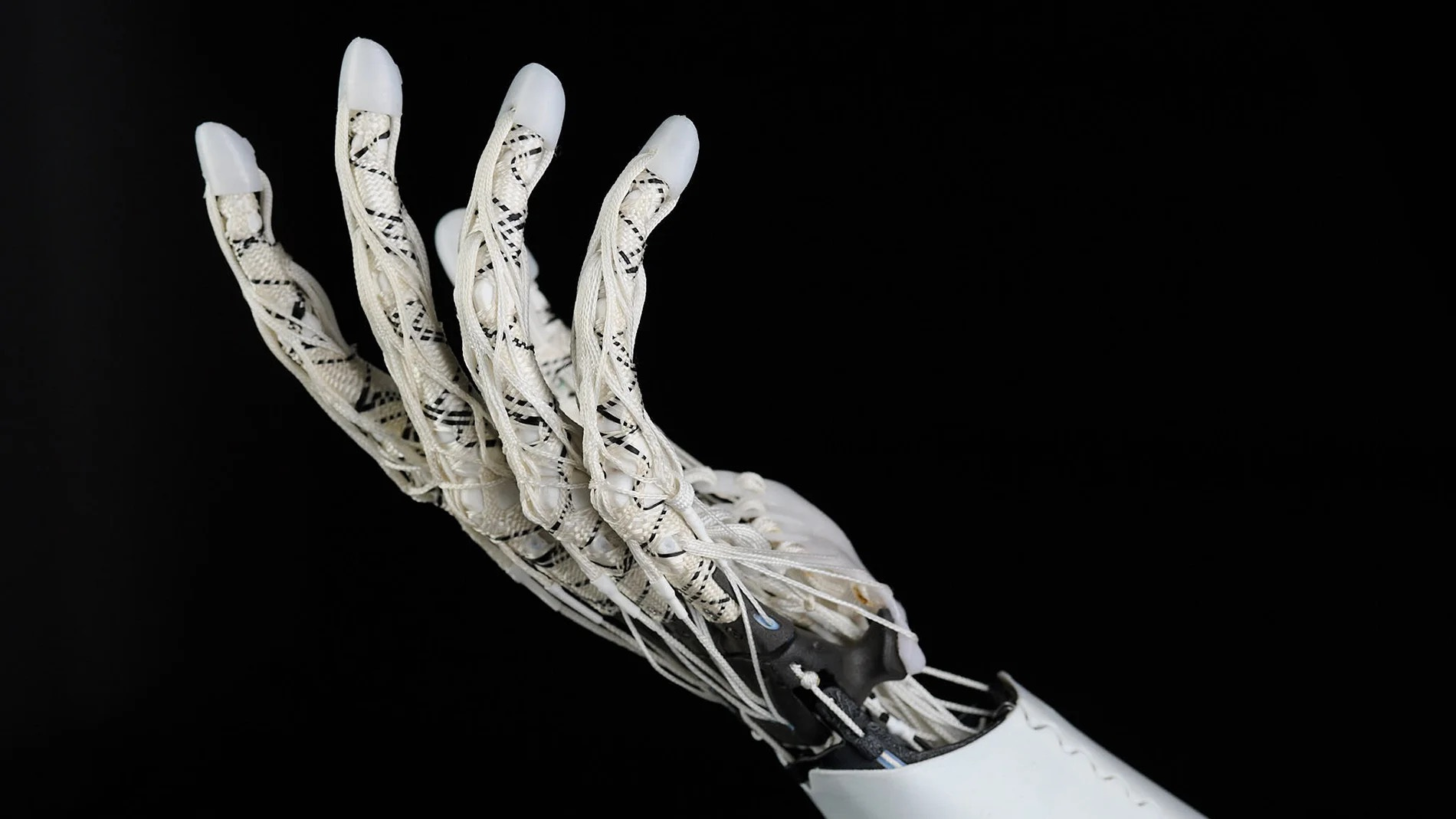
Similarly, Hungarian robotics company Allonic looked beyond rigid tooling and developed a process called 3D Tissue Braiding, inspired by the textile industry, to produce humanoid robot components around lightweight skeletal cores in mere minutes. By weaving thousands of high-strength fibers and elastic materials around a simple 3D-printed skeletal core, Allonic created robotic structures that move more like biological systems at a fraction of the cost of traditional rigid tooling. While a traditional robotic hand can cost up to $30,000, Allonic’s automated fabrication process dramatically reduces mechanical complexity, eliminating hundreds of individual parts while delivering superior performance.
All of this is enabled by the platform’s AI software, which converts design algorithms directly into machine code and guides the automated braiding process.
In both of these examples, there was no meaningful manufacturing or design precedent to follow as these were uncharted waters. While it’s clear that the combination of additive manufacturing and AI released the genie from the bottle, it’s arguably also true that the human hand and imagination made it possible.
Notably, once the constraints of industrial-era manufacturing were removed through additive production, the resulting designs began to resemble biology more than industry. Structures optimized by evolution over millions of years displaced the rigid industrial-age geometries imposed by casting, machining, and assembly-line production. In the absence of these constraints, the most foundational elements of manufactured production reverted back to nature.
How appropriate, then, that the factories of the future may increasingly be populated by humanoid robots resembling their biological counterparts.
That act of imagining beyond precedent extends well beyond manufacturing.
The Man-Machine
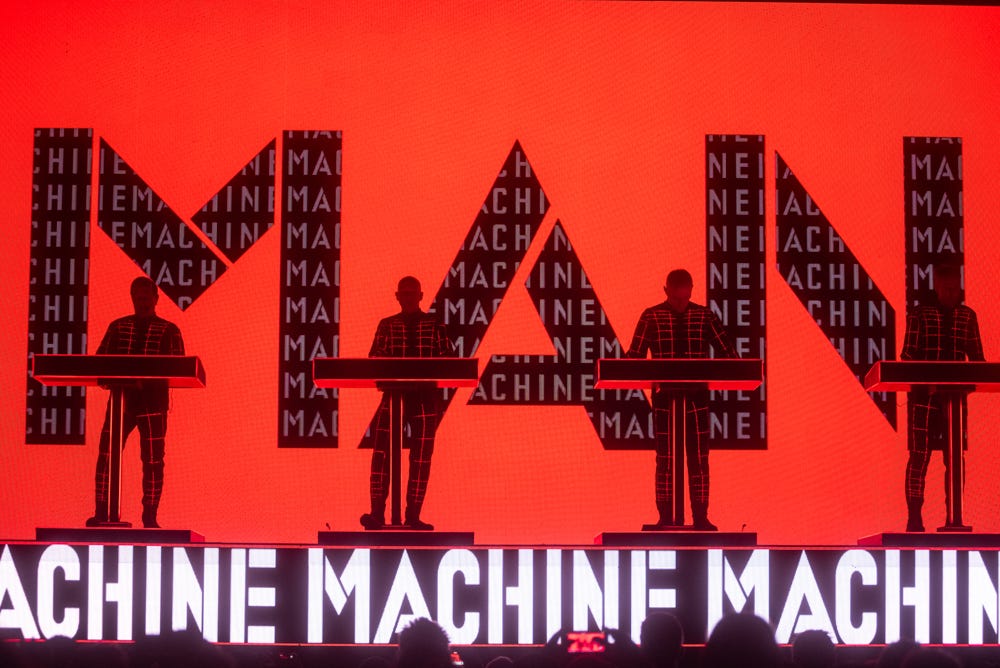
More than half a century before today’s AI era, German techno pioneers Kraftwerk were imagining a future that had yet to arrive. Beginning in the late 1960s and early 1970s, they envisioned a world in which robotic performances could take place simultaneously around the globe.
To create their distinctly futuristic sound—one that would go on to underpin much of techno and hip-hop—they modified existing technologies and, in some cases, built their own instruments when nothing commercially available produced the sound they envisioned. Like the engineers at Czinger and Allonic decades later, they were unwilling to accept the limitations of existing tools when pursuing something genuinely new.
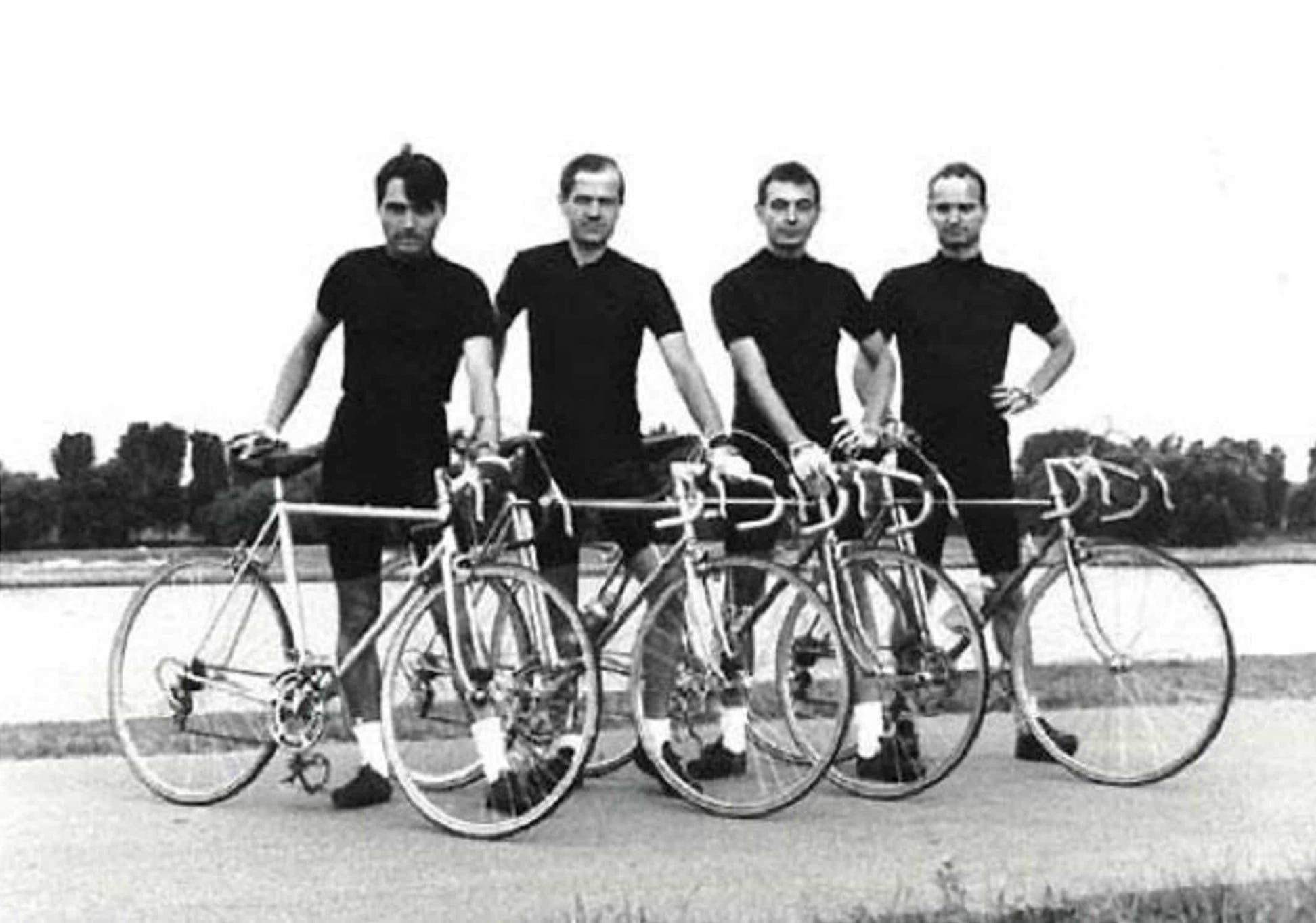
Cycling enthusiasts, their 1978 album The Man-Machine explored the relationship between humans and technology as force multipliers. Cycling represents the ultimate “man-machine” philosophy: the perfect union of human athleticism and mechanical propulsion. When a human rides a bicycle, they become the most energy-efficient traveler in the animal kingdom. Founding member Ralf Hütter famously described cycling as constant forward motion, declaring: “He who stops falls over.” Like a shark, it’s move forward or perish.
Bridging the Chasm
This, then, is the lens through which to view AI. It is the human envisioning the bicycle before riding it into a brave new future. It’s sea-change innovation in the absence of meaningful precedent. Yes, AI can help iterate and evolve. It can accelerate the path to advancement at breakneck speed.
What it still can’t do, at least not yet, is execute a true net-new rethink without the right person at the controls bridging the chasm where precedent does not exist. That human-in-the-loop remains, at least for the foreseeable future, indispensable to our AI-powered future.